
High peak tents
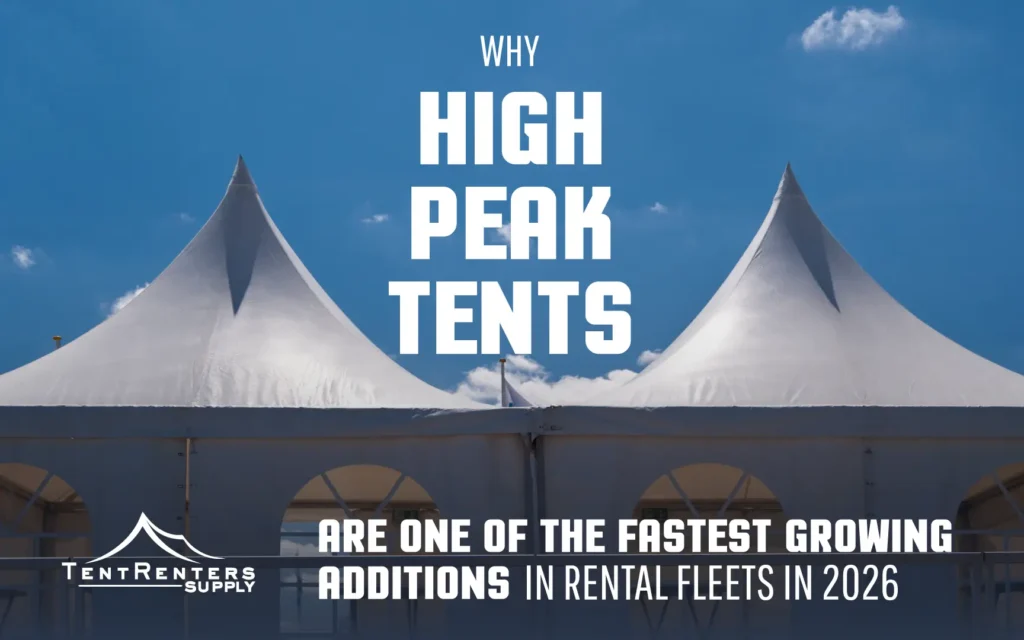
Why High Peak Tents Are One of the Fastest-Growing Additions to Rental Fleets in 2026
Sep
The event rental market has grown substantially, and the tents clients are specifically requesting have shifted along with it. High peak tents have moved from a specialty item to a core fleet component for a lot of operators, and the reason is straightforward: they deliver the look clients want at a cost that still books. Here’s the business case and a practical framework for which sizes to add.
The Event Rental Market Is Growing: and High Peak Tents Are Leading the Way
Why a Growing Event Rental Market Creates Opportunity for Rental Operators
The party and event rental industry represents a multibillion-dollar market that has continued expanding, driven by outdoor event demand, the sustained popularity of non-traditional venues and clients increasingly willing to spend on experience and presentation rather than just logistics.
For rental operators, growth in the market is only useful if your inventory matches what clients are asking for. Operators who keep stocking exactly what they stocked five years ago find themselves competing on price for standard frame tents while competitors book premium rates for structures clients specifically requested by name.
Why Clients Are Requesting High Peak Tents More Than Ever
Social media has changed what clients expect from an event tent. A wedding, corporate event or milestone party is going to be photographed extensively, and clients are thinking about how the space looks in those photos before they book.
A standard flat-top frame tent is functional. A high peak tent, with its soaring center and sculptural profile, photographs as an intentional design element rather than weather coverage. Clients have seen them, they know what they want, and increasingly they ask for them by name.
How High Peak Tents Are Filling the Gap Between Standard Frame Tents and Premium Structures
There has always been a gap in the market between standard frame tents and high-end clearspan structures. Frame tents are affordable and practical but visually plain. Clearspan structures look impressive but carry costs, install complexity and crew requirements that put them out of reach for many jobs.
High peak tents sit in between, and that is exactly why they have grown. They deliver dramatic visual impact at a price point and install complexity much closer to a standard frame tent, which means operators can offer an upgrade without the capital investment and labor burden of a structure tent.
What Makes a High Peak Tent Different from a Standard Frame Tent
The Soaring Center Peak: How It’s Created Without Ground-Level Center Poles
The defining feature is the dramatic peak rising from the center of the tent. Unlike a traditional pole tent, which achieves that profile using center poles planted in the middle of the floor, a high peak frame tent creates it through the frame structure itself.
That means you get the visual drama of a peaked top with a completely clear interior. No poles in the middle of the dance floor, no poles interrupting a seating layout, no explaining to a client why there is a post where the head table was supposed to go.
Cross Cable and Frame Tension Design: More Open Space, Easier Setup
The peak is formed by the frame geometry and tensioning system rather than by ground-supported poles, which keeps the entire footprint usable. Like other frame tents, high peak tents are held down with weights rather than requiring stakes driven into the ground, so they install on asphalt, concrete, decks and other surfaces where pole tents are not an option.
For crews, that combination means a tent that produces a premium result without a dramatically more complex install than they are already accustomed to.
Why High Peak Tents Deliver the Aesthetic Clients Want at a Price Point That Works
The economics are what make high peak tents a growth category rather than just a nice option. Because they install on any surface, you can book venues that pole tents cannot serve. Because the interior is fully clear, you can accommodate layouts that pole tents complicate. And because they command a premium over standard frame tents while costing substantially less than clearspan structures, the return on the inventory investment tends to be favorable.
The High Peak Tent Sizes Rental Companies Are Adding to Their Fleets
10×10 High Peak Tent: The High-Impact Booth and Vendor Tent
The 10×10 is the volume size, and it is frequently where operators see the fastest payback simply because of how often it books.
It serves vendor booths at festivals and markets, hospitality tents at outdoor events, registration and check-in stations, and small-scale coverage for backyard gatherings. Its advantage over a standard pop-up is immediate visual differentiation, a vendor row of flat canopies with one high peak tent in it has an obvious focal point.
Because they are relatively inexpensive per unit and book in multiples, operators serving vendor-heavy events often stock these in real depth rather than ones and twos.
15×15 High Peak Tent: The Versatile Mid-Size for Smaller Events and Add-On Coverage
The 15×15 fills the gap between booth coverage and full event coverage, and it is often the most underutilized size in a fleet simply because operators skip from 10×10 straight to 20×20.
It handles smaller gatherings, bar and catering stations, lounge areas and entry coverage. It is also the natural add-on sale: a client with a 20×20 who needs separate coverage for food service frequently wants something that visually matches rather than a mismatched standard frame tent.
20×20 High Peak Tent: The Workhorse of the High Peak Line for Parties and Corporate Events
The 20×20 covers 400 square feet and comfortably seats roughly 30 to 40 guests depending on layout. It is the size most operators build their high peak inventory around.
It books for backyard parties, corporate events, small weddings, ceremony coverage and dining areas. If you are adding high peak tents to your fleet for the first time and need a single size to prove the concept, this is usually it.
When to Stock Multiple Sizes vs. Going Deep on One
The answer depends on what you actually service. Operators working festivals, markets and vendor-heavy events should go deep on 10x10s, since those book in quantity and running short means turning down whole jobs. Operators serving private events and corporate clients generally do better spreading across 15×15 and 20×20, since those bookings are usually one or two tents at a time across a wider range of layouts.
Most operators building out a high peak line start with a handful of 20x20s to establish demand, then add 10x10s in depth and 15x15s for flexibility once the bookings justify it.
Why Fall Is the Right Time to Add High Peak Tents to Your Inventory
Fall Harvest Festivals, Corporate Events, and Outdoor Dining Demand Is Peaking
Fall brings a dense run of events particularly well suited to high peak tents: harvest festivals and fall markets with heavy vendor participation, corporate events and client appreciation gatherings, outdoor weddings in the most popular season of the year in many regions, and extended outdoor dining as temperatures become pleasant again.
High Peak Tents Pair Naturally with Sidewalls for Cooler Weather Events
As evenings cool, sidewall attachment becomes a standard part of the booking rather than an occasional add-on. High peak tents accept sidewalls like any frame tent, and the taller profile means an enclosed high peak tent still feels open and spacious rather than cramped.
That combination, a visually impressive tent that also handles weather, is exactly what fall and early winter clients are looking for, and it is an add-on sale on nearly every booking.
Lead Times to Know Before the Fall Rush Hits
Custom colors, striped tops and specific configurations take production time. If you are adding inventory with any customization, that order needs to be placed well before the bookings you are hoping to serve. In-stock standard configurations move faster, but even those are subject to seasonal demand.
The practical guidance: order for the season after the one you are currently in. Operators who wait until they are turning down bookings are already a season behind.
What to Look for When Buying Commercial High Peak Tents
Vinyl Weight and Fire Rating for Commercial Use
Heavier vinyl weights hold up better to UV exposure and repeated installation cycles, which matters more in rental use than in any other application. Fire compliance under NFPA 701 and CPAI-84 standards is not optional for tents used at public and commercial events, and documentation gaps become your liability, not your supplier’s.
Frame Construction and Compatibility with Sidewalls and Accessories
Check that the frame system accepts sidewalls, and specifically whether it is compatible with sidewalls you may already stock. Buying a high peak line that requires an entirely separate sidewall inventory changes the economics of the purchase considerably.
Aluminum frame construction keeps weight manageable for crews while meeting the load and wind rating requirements commercial events demand.
Ordering Direct from a US High Peak Tent Manufacturer
Buying direct from the manufacturer means shorter lead times, flexibility on custom sizing and colors, compliance documentation built in rather than chased down, and ongoing access to matching replacement parts as the tents move through years of rental rotation.
Shop High Peak Tents at Tent Renters Supply
Tent Renters Supply manufactures commercial high peak tents in the USA, built to the fire rating and wind standards your bookings require and available in the sizes rental operators actually move. Whether you are testing the category with a few 20x20s or building out a full high peak line, our team can help you spec it for the events you service. Shop our high peak tent inventory today.
